A patient can carry more than one strain of tuberculosis at once. Mixed infections distort resistance calls and complicate treatment, but they are easy to miss in a standard sequencing pipeline, which tends to report a single consensus genome per sample.
Reading the figure
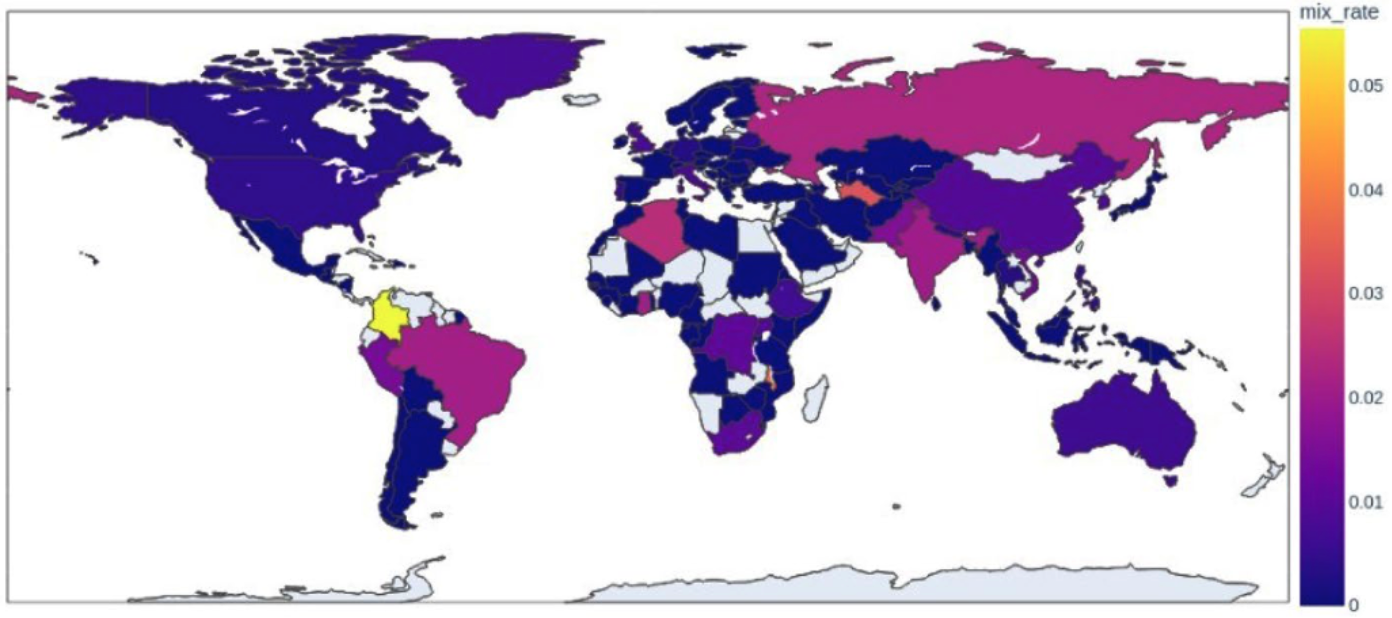
Running the detector across more than 5,000 public genomes gives a mixed-infection rate per country, mapped here.
Two things are worth noting about the scale. It tops out around 0.05, so even the highest national rates are a small minority of cases, but that minority is large enough to matter when the consequence is a wrong resistance profile. Colombia is the clear outlier in yellow, with Russia, Brazil and parts of South Asia and sub-Saharan Africa sitting in the middle of the range.
The grey areas deserve as much attention as the coloured ones. They are countries with no public genomes available, and they include much of the region where TB burden is highest. The map therefore shows where mixed infection has been measured, which is not the same as where it occurs, and the gaps are a statement about sequencing coverage rather than about the disease.
Approach
- A Python pipeline using Gaussian mixture models to detect mixed infections from whole-genome sequencing data
- Modelled expected allele-frequency distributions across more than 5,000 public isolates
- Benchmarked detection thresholds against those distributions
Findings
- Mixed infections are significantly associated with genotypic drug resistance
- That association points to both greater transmission complexity and a diagnostic blind spot
- The method is designed to slot into existing TBProfiler workflows for strain-level resistance resolution