Mutations under positive selection are the ones most likely to matter clinically, but telling them apart from neutral variation is hard. Standard methods treat mutations independently and throw away the evolutionary structure that connects them. This model reads that structure directly.
Reading the figure
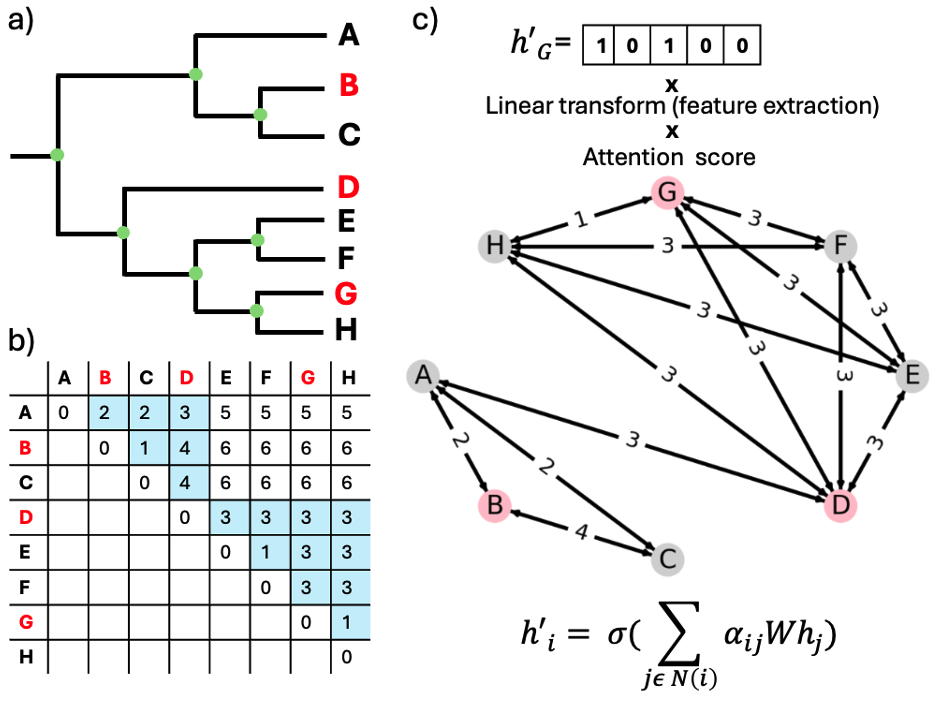
Panel a is a phylogeny of eight isolates. Three of them, B, D and G, carry the mutation being tested, marked in red. The whole question sits in that pattern: is the mutation appearing repeatedly because it is useful, or does it just sit in one branch of the family tree because it was inherited once?
Panel b converts the tree into numbers. Each cell is the distance between two isolates along the tree, so it records how closely related each pair is without needing the tree drawing itself.
Panel c turns those distances into a weighted graph and runs graph attention over it. Each node’s representation is updated as a weighted sum over its neighbours, and the attention weight decides how much each neighbour counts. That is what lets the model use the shape of the tree rather than just the list of mutations. A mutation that keeps surfacing between distantly related isolates is evidence of independent, recurrent emergence, which is the signature of positive selection. The same mutation confined to one tight clade is more likely a single inherited event. The attention weights are also what makes the model inspectable: you can see which comparisons drove a given call rather than taking the score on trust.
Approach
- A graph attention network (GAT) combining phylogenetic tree topology with SNP presence
- Attention weights the topologically informative parts of the tree, which also makes decisions inspectable
- Trained and evaluated on Mycobacterium tuberculosis phylogenies
Results
- 88% accuracy in identifying positively selected mutations
- Flagged high-confidence adaptive mutations that the WHO catalogue currently lists as uncertain
- Points toward novel resistance markers usable for long-term genomic surveillance