TOAST designs targeted amplicon panels for detecting drug resistance in Mycobacterium tuberculosis. Sequencing whole genomes is often too costly for routine diagnostics, so the practical question is which small set of regions to amplify. TOAST answers that from the data.
Reading the figure
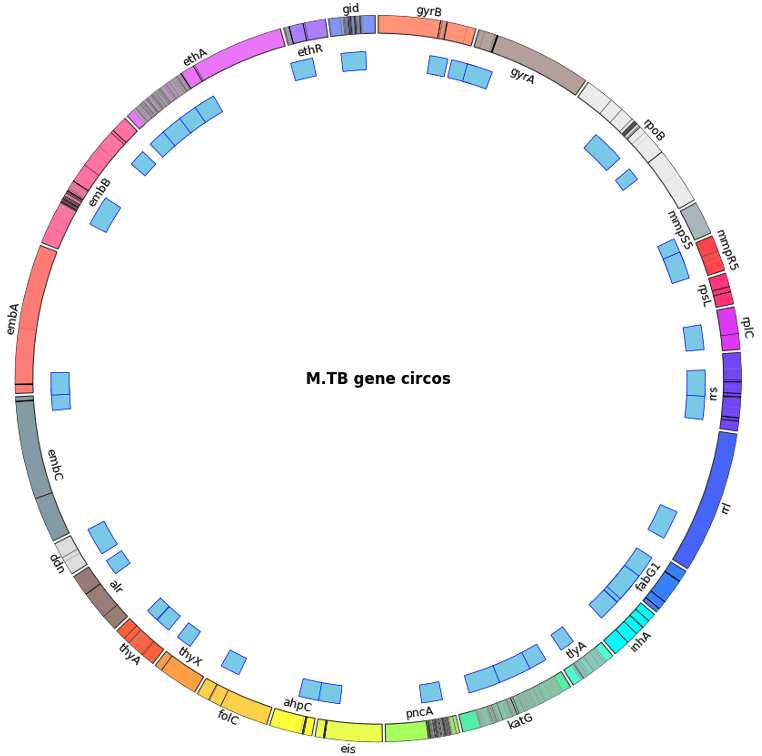
The outer ring is the M. tuberculosis genome, with the genes that carry resistance mutations labelled around it: gyrA and gyrB for fluoroquinolones, rpoB for rifampicin, katG and inhA for isoniazid, pncA for pyrazinamide, the embA/embB/embC cluster for ethambutol, rrs and rpsL for aminoglycosides, and so on. The dark ticks inside each coloured band are individual resistance-associated positions drawn from the mutation-frequency data.
The pale blue blocks on the inner ring are the amplicons TOAST selected, and the design problem is visible in the gap between the two rings. Mutations are not spread evenly: they cluster tightly in some genes and scatter across others. So a good panel is not one amplicon per gene. It is a set of windows placed to capture as many high-frequency positions as possible per unit of sequencing, which is why genes like embB and ethA take several amplicons while others are covered by one.
Approach
- Ranks candidate regions using mutation-frequency data drawn from over 50,000 TB genomes
- Optimises primer selection so each amplicon carries as much resistance information as possible
- Accepts custom inputs, so panels can be retargeted to other organisms or resistance profiles
Results
- A final 33-amplicon panel covering over 97% of key resistance markers
- Validated experimentally using Nanopore sequencing
Availability
Command-line tool, installable Python package, and an interactive web app.